
Blog · 19 October 2026 · 9 min read
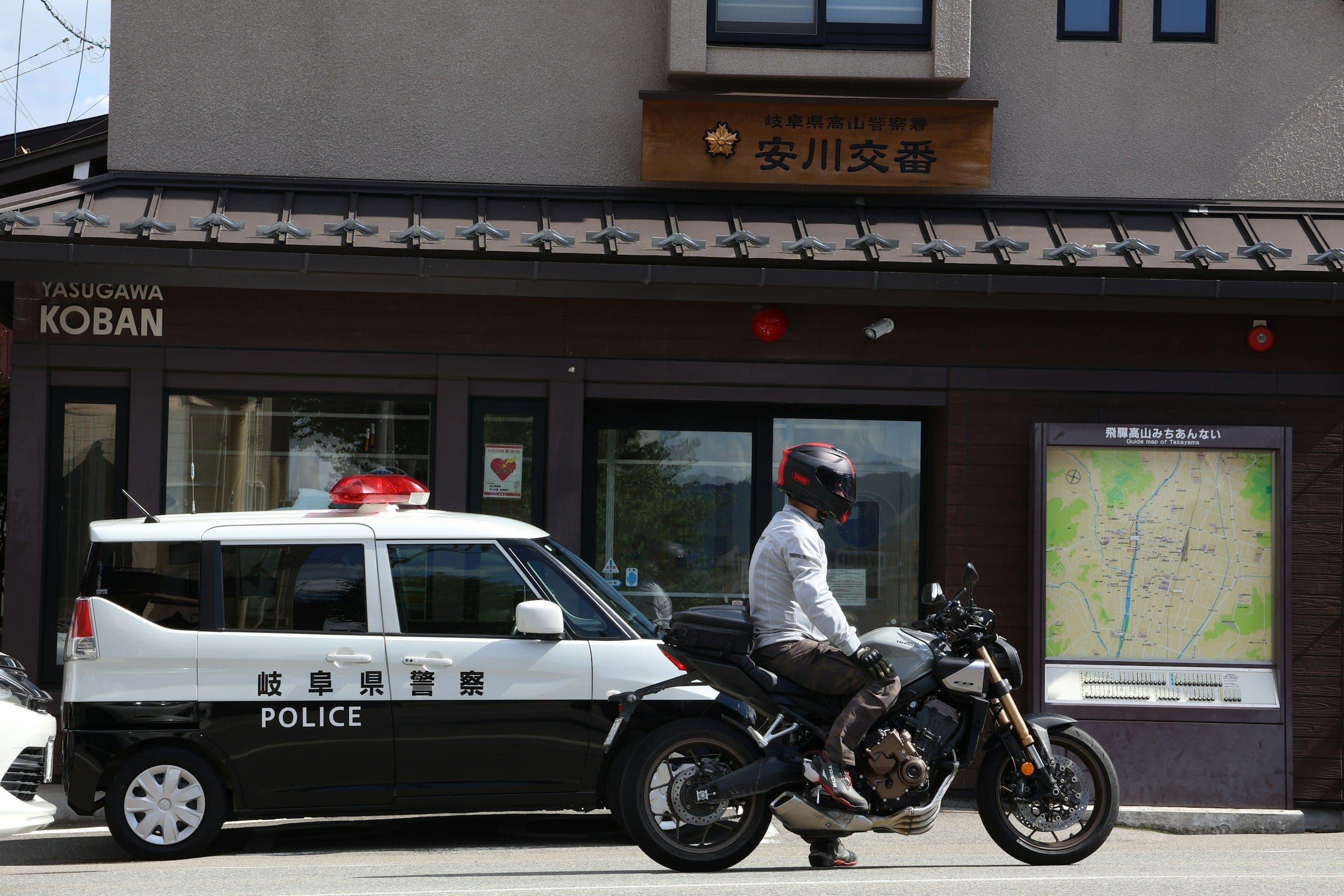
Photo: Yanhao Fang on Unsplash
Japanese police are polite, patient and very thorough. A traffic stop on a motorcycle is usually calm and quick, but it follows a fixed routine that surprises many visitors: you may be invited to sit in the patrol car, the officer fills in a lot of paperwork, and nobody ever asks you for money at the roadside. This guide explains what to expect, what to carry, how fines work and what to do if things go badly.
The short version
- Pull over to the left where it is safe, turn off the engine and take your helmet off.
- Hand over your home licence, International Driving Permit and passport. Riding without them is an offence even if you have them at the hotel.
- Stay polite and calm. Never offer money. Police do not collect fines at the roadside.
- A blue ticket is a fine you pay at a bank or post office within 8 days. A red ticket is a criminal case.
- Every ticket adds points, and on an International Driving Permit too many points mean a ban from riding in Japan.
- If you need help, call the Japan Visitor Hotline: 050-3816-2787 (24 hours).
Why riders get stopped
Most stops are for a handful of everyday mistakes, and several of them are rules visitors do not have at home.
- Not stopping fully at a stop sign. The sign is a red inverted triangle marked 止まれ. Japan’s police record more of these offences than any other, often by waiting just past the junction. Put a foot down and count to two.
- Speeding. Limits are low, often 40 to 60 km/h on ordinary roads, and police use radar, unmarked cars and white police motorcycles.
- Crossing a solid yellow centre line. It means no overtaking or crossing, even on an empty mountain road.
- Railway crossings. Every vehicle must stop before the tracks, look and listen, even when the barriers are up.
- Holding a phone. Touching a phone while riding, including to change the route, is an offence. Mount it and set the route before you leave.
- Riding on the pavement or through a closed road, often by following a navigation app.
Our guide to renting a motorcycle in Japan covers the other road rules that catch visitors out, including speed limits, passenger rules and parking.
Being pulled over
A patrol car or police motorcycle will switch on its red lights and often use a loudspeaker. The message is usually in Japanese and may describe your bike, its colour or its number plate, followed by 止まってください (please stop). Some police cars also show a “STOP” or “止まれ” message on a rear display.
- Indicate left and pull over somewhere safe. On an expressway, follow the police vehicle to a safe place.
- Turn the engine off, put the bike on its stand and take your helmet off so the officer can see and hear you.
- Stay with the bike and wait for the officer to come to you. Do not walk towards the police car.
- Keep your hands visible and tell the officer if you are about to reach into a pocket or bag.
During the stop
The officer will tell you what you did and ask for your licence. As a visitor, that means three documents together:
- your home motorcycle licence,
- your 1949 International Driving Permit with the motorcycle category, or the official Japanese translation for licences from Germany, France, Switzerland, Belgium, Monaco and Taiwan,
- your passport.
If you are on a rental bike, the officer may also ask for the rental agreement, so keep it with you. Not carrying your licence is an offence, so keep all three on you every time you ride, not in your luggage or at the hotel.
For anything more than a warning, the officer will usually ask you to sit in the back of the patrol car while they fill in the ticket. This is normal and is not an arrest. It is simply where the paperwork is done. The officer will ask for your name, date of birth and where you are staying in Japan, so have your hotel address on your phone.
If you do not understand, say so. Many officers use a translation app or call an interpreter. Ask the officer to explain anything you are asked to sign before you sign it. Arguing at the roadside rarely helps. If you think the ticket is wrong, say so calmly and politely.
Never offer money. Japanese police do not take payment at the roadside, and offering cash to an officer can be treated as attempted bribery.
White, blue and red tickets
Japan sorts traffic offences into three kinds, and the colour of the paper tells you which one you have.
| Ticket | Used for | What happens |
|---|---|---|
| White (no fine) | Minor offences that only carry points | Points go on your driving record in Japan. No fine to pay. |
| Blue (交通反則告知書) | Most everyday offences: stop signs, moderate speeding, phone use, lane and overtaking offences | Points go on your record. Pay the fine at a bank or post office and the case is closed, with no criminal record. |
| Red | Serious offences: drunk riding, riding without a valid licence, dangerous or obstructive riding, very high speeds | Points go on your record, usually enough for a riding ban on their own. It is also a criminal case: you may have to appear before prosecutors or a court, and the penalty can be a large fine or prison. |
Speeding becomes a red-ticket offence at 30 km/h or more over the limit on ordinary roads, and 40 km/h or more on expressways. Below that it is a blue ticket. Blue-ticket fines for motorcycles range from a few thousand yen to the low tens of thousands. For example, not stopping at a stop sign costs a motorcyclist ¥6,000. The ticket shows the exact amount.
What happens to your International Driving Permit
Japan cannot suspend your home licence, but it controls whether you may ride in Japan. Under Article 107-5 of the Road Traffic Act, visitors riding on an International Driving Permit or a Japanese translation of their licence are on the same points system as Japanese licence holders. Instead of a suspension, the penalty is a ban on riding or driving in Japan.
- White and blue tickets add points, typically 1 to 3 per offence. For example, missing a stop sign is 2 points and holding a phone is 3. One ticket on its own does not stop you riding, and you keep your permit.
- 6 points within three years is enough for a ban if you have no earlier record in Japan. Two or three ordinary blue tickets on one trip can get you there. A red ticket for speeding 30 km/h or more over the limit is 6 points by itself, and riding over the drunk-driving limit carries even more. A ban at this level lasts up to six months.
- 15 points or more brings a ban of one to five years.
- The most serious offences bring a ban of 3 to 10 years. These are riding drunk, a hit-and-run, and injuring or killing someone deliberately or through dangerous riding. After a serious accident, the police can also ban you for 30 days on the spot.
If you are banned, you must hand your permit in to the police, and the ban is written on the permit itself. If you ride on a Japanese translation, the rules are the same, but what you hand in is your home licence with its translation attached. You can ask for it back when the ban ends or when you leave Japan, whichever comes first. The ban is recorded nationally and applies to you, not just to that piece of paper. If you come back to Japan while it is still running, you must hand your permit in again, and a new permit from home does not get you around it. Riding during a ban is treated as riding without a licence.
For a visitor on a short trip, the practical effect is simple: a ban ends your riding in Japan for this trip, and possibly the next. A longer ban comes with a formal hearing and can take weeks to issue, so it may only be decided after you have gone home. It then applies from your next visit.
Paying a fine as a visitor
With a blue ticket you are given a payment slip (納付書). The process set out by Japan’s prefectural police is:
- Pay within 8 days, counting the day you got the ticket, in cash at a bank or post office counter with the slip.
- If you miss that, you are called to the traffic infringement centre to receive a formal notice, and then have 11 days to pay.
- If you still do not pay, the case leaves the fine system and goes to the criminal process.
For a visitor, the simple rule is to pay before you leave Japan. Take the slip to a bank or post office on the next weekday. Banks and post office counters keep office hours, so do not leave it until the day you fly. Keep the receipt until you are home. If you are on a guided tour, tell your ride leader, who can help you find a counter and explain the slip.
Checkpoints and breath tests
Police set up checkpoints, especially at night, at weekends and during holidays, where every vehicle is waved down. You will be asked to show your licence and may be asked to breathe into a breath tester. Refusing the test is an offence in its own right. Japan’s drunk-driving limits are very low, and passengers and anyone who lent you the vehicle or served you drinks can also be punished. Do not drink at all on a riding day.
Parking tickets and cameras on a rental bike
Two kinds of offence reach you after the event rather than at the roadside.
- Parking. If you leave the bike in the wrong place, an officer or parking warden may stick a yellow notice (確認標章) on it. Do not ignore it or peel it off and ride away. Call your rental shop straight away. The usual process is that the rider goes to the police station named on the notice and pays the fine. If you do not, the shop is ordered to pay and will charge you, often with an extra fee. Many shops also hold back part of your deposit until the ticket is settled.
- Speed cameras. Some fixed and mobile cameras photograph vehicles going well over the limit. The notice goes to the bike’s owner, so the rental shop will be contacted and will pass on your details. Serious speeding is a red-ticket case even when it is caught by camera.
If it is serious
If you are involved in an accident, ride without a valid licence, fail a breath test or are taken to a police station, the situation is different.
- After any accident, call 119 if anyone is hurt and 110 for the police, then your rental shop. Our guide to what to do after a motorcycle accident in Japan goes through every step.
- You can ask the police to contact your embassy or consulate. Consular staff cannot get you released, but they can give you a list of English-speaking lawyers and contact your family.
- You can ask for an interpreter. Do not sign a statement you cannot read or do not agree with.
- The Japan Visitor Hotline (050-3816-2787), run by the Japan National Tourism Organization, answers 24 hours a day in English, Chinese and Korean and can help you communicate.
The most serious mistake visitors make is riding with the wrong paperwork. A 1968-format permit, or one without the motorcycle category, means you are riding unlicensed, which is a red-ticket offence and also voids the rental insurance. Our International Driving Permit guide for Japan shows how to get the right one before you travel.
Useful phrases
| Meaning | Say it | Japanese |
|---|---|---|
| Please stop | Tomatte kudasai | 止まってください |
| Please show me your licence | Menkyoshō o misete kudasai | 免許証を見せてください |
| Passport | Pasupōto | パスポート |
| Do you speak English? | Eigo wa hanasemasu ka? | 英語は話せますか? |
| I don’t understand | Wakarimasen | わかりません |
| I’m sorry (for what happened) | Sumimasen deshita | すみませんでした |
| Please contact my embassy | Taishikan ni renraku shite kudasai | 大使館に連絡してください |
Riding with a guide
On our guided motorcycle tours, the ride leader knows the local rules, rides the route with you and is there to translate if you are stopped. You still need your own licence and permit. Browse the motorcycle tours or ask us about riding in Japan.
Please note. We wrote this guide in October 2026 from Japanese police and tourism organisation pages. Fines and procedures change and can differ by prefecture. It is general information, not legal advice. If you are charged with a serious offence, contact your embassy and a lawyer.
Sources
- e-Gov: Road Traffic Act, Article 107-5 (Japanese)
- e-Gov: Road Traffic Act Enforcement Order, Article 40 (Japanese)
- Kyoto Prefectural Police: The traffic infraction notification system (Japanese)
- Kanagawa Prefectural Police: Paying a traffic fine (Japanese)
- Shizuoka Prefectural Police: Parking violation Q&A (Japanese)
- JNTO: Japan Visitor Hotline
- JAF: Driving in Japan with a foreign licence
Frequently asked questions
Can Japanese police fine a tourist on the spot?
Police write the ticket on the spot, but they never take money. For a minor offence you get a blue ticket and a payment slip, and you pay the fine at a bank or post office within 8 days. Anyone at the roadside asking you for cash is not following the real procedure.
What happens if I leave Japan without paying a traffic fine?
If the fine is not paid in time, the case leaves the fine system and can go to prosecutors as a criminal matter. That can cause problems on a later visit, and rental companies may refuse to rent to you again. Pay before you fly; most tickets can be paid at any bank or post office.
Will a traffic ticket in Japan affect my International Driving Permit?
Yes. Visitors on an International Driving Permit are on the same points system as Japanese drivers. Two or three ordinary tickets, or one red ticket for serious speeding, can be enough for a ban on riding in Japan. If you are banned, you hand your permit in until the ban ends or you leave Japan. The same applies if you ride on a Japanese translation of your licence, except that you hand in your licence and its translation. Japan cannot suspend your home licence.
Do I have to take a breath test in Japan?
Yes. Refusing a breath test at a police checkpoint is an offence in its own right. Japan's drunk-driving limits are very low, so the only safe amount to drink before riding is nothing.
What happens if I'm caught riding without an International Driving Permit?
Riding without a valid licence for Japan is treated as unlicensed riding, which is a serious criminal offence handled with a red ticket, not a fine you pay at the bank. A 1968-format permit, or one without the motorcycle category, does not count.
Will the police speak English?
Some officers do, and many use translation apps or phone interpreters. Stay calm, speak simply, and if you need help you can call the Japan Visitor Hotline on 050-3816-2787, which runs 24 hours a day in English, Chinese and Korean.