
Blog · 19 October 2026 · 10 min read
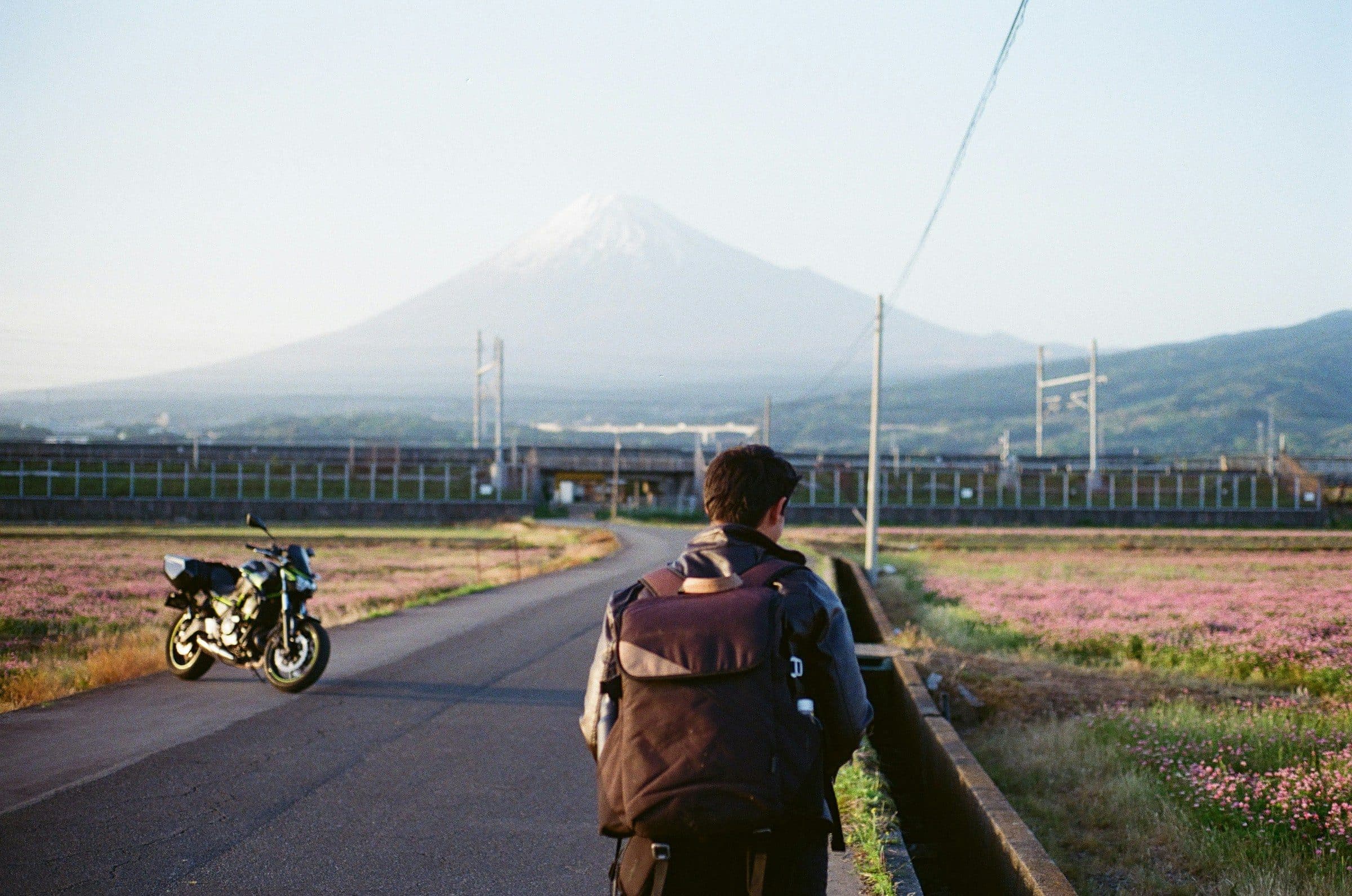
Photo: Spenser Sembrat on Unsplash
Renting a motorcycle is one of the best ways to see Japan. The roads are smooth, drivers are patient, and an hour out of any city you are on mountain passes and coastal roads with almost no traffic. Renting is easy once you know how it works. This guide covers the documents you need, where to rent, what it costs, how insurance works and the road rules that catch visitors out.
The short version
- Bring a full motorcycle licence from home, a 1949 International Driving Permit with the motorcycle category and your passport.
- Book weeks ahead, especially for a particular model, for spring, autumn or a Japanese holiday.
- Choose a bike over 125cc if you want to use expressways.
- Pay for the damage waiver. Even with it, expect a Non-Operation Charge if the bike is damaged.
- Ask for an ETC card for tolls, and plan to return the bike to the shop where you picked it up.
Documents you need
Every shop checks three documents at the counter, and none of them can be arranged after you land. Without all three you will not get the keys.
- Your home motorcycle licence. It must be a full licence, not a learner permit, valid for your whole trip and cover the size of bike you book. If your licence has tiers, such as an A2 licence in Europe or a restricted licence in Australia, the shop will hold you to it.
- An International Driving Permit (IDP) or a Japanese translation. Japan only accepts the 1949 Geneva Convention permit, and for anything over 50cc it must show the motorcycle category (section A). Licences from Germany, France, Switzerland, Belgium, Monaco and Taiwan use an official Japanese translation instead. Our guide to getting an International Driving Permit for Japan covers exactly how to get the right one in the US, UK, Europe and Australia.
- Your passport. Shops use it to check your identity and that you are in Japan as a visitor.
Most shops also want a credit card for payment or a deposit, and many have a minimum age, often 18 to 21. Check both before you book.
Where to rent
Most rental bikes in Japan come from chains with many branches or from motorcycle dealers that keep a few bikes for rent. Any of these work for visitors, but English support and the choice of models vary a lot.
| Option | Good for | Things to know |
|---|---|---|
| Rental819 | The widest choice, with about 100 shops across Japan, including Tokyo, Osaka and Kyoto | English booking and an English email desk. Bikes go back to the shop you rented from. |
| HondaGO BIKE RENTAL | Current Honda models from Honda dealers nationwide | Booked through an app, mostly in Japanese. Ask the dealer about foreign licences first. |
| Brand and dealer rentals | A specific make, such as a dealer that rents its own demo bikes | Few bikes per shop, so book early. English varies by shop. |
| Visitor-focused rental and tour companies | English throughout, sometimes one-way rentals or delivery | Usually cost more than the chains. |
If you want a particular model, book it early. Many shops only have one or two of each, and bikes can be stored at a central depot and brought to your shop for the day you booked.
Choosing a bike
Japan sorts motorcycles into a few size classes, and the class decides where you can ride.
| Class | Engine size | Expressways? | Good for |
|---|---|---|---|
| Scooter or small bike | Up to 125cc | No | Getting around one city or island |
| Mid-size | 126cc to 400cc | Yes | Mountain roads, light touring, most riders |
| Large | Over 400cc | Yes | Long-distance touring and riding two-up |
A 250cc to 400cc bike is a good choice for most visitors. Japanese mountain roads are narrow and twisty, and speed limits are low, so a light bike is often more fun than a big tourer. If you plan long expressway days, carry a passenger or have lots of luggage, go bigger. Ask for side cases or a top box when you book, since storage is limited and a big backpack gets tiring fast.
What it costs
Prices change with the shop, the model and the season, so treat these as rough ranges at the time of writing.
| Item | Typical cost |
|---|---|
| Scooter, per day | About ¥2,500 to ¥9,000 |
| Mid-size or large bike, per day | About ¥10,000 to ¥22,000 |
| Extra insurance or damage waiver | Often ¥800 to ¥2,000 a day |
| Helmet | Free to about ¥1,000 a day |
| Jacket, gloves and other gear | Only at some shops, priced per item |
| Side cases, phone mount, GPS | A few hundred to about ¥1,500 a day each |
| Fuel and expressway tolls | Paid by you during the rental |
Multi-day rentals usually cost less per day. Riding gear is the item visitors most often forget. Many shops only rent helmets, and rental helmets are often made for Asian head shapes, so if you have your own helmet and jacket, bring them.
Insurance, the damage waiver and the NOC
Rental insurance in Japan comes in layers, and it helps to know them before you sign.
- Included insurance. The rental price normally includes liability cover for injury or damage to other people and their property. Some shops include partial theft cover too.
- Damage waiver. Usually optional. It caps what you pay for damage to the rental bike at a fixed deductible. Without it, you can be charged for the full repair, or the bike’s full value if it is written off. Take it.
- Non-Operation Charge (NOC). This covers the shop’s lost income while the bike is being repaired, and you pay it even with the damage waiver. At Rental819, for example, there is no charge for light damage such as a bent lever. Medium damage costs ¥20,000 if you can ride the bike back and ¥50,000 if it has to be towed.
- Your own travel insurance. Rental cover is for the bike and for other people. It does not pay your medical bills. Check that your travel insurance covers riding motorcycles, as many policies exclude it or limit the engine size.
Booking and pick-up
- Book online and note the shop’s opening hours, as many close in the early evening and on one weekday.
- Bring your licence, IDP or translation and passport to the counter. A photo on your phone is not accepted.
- Walk round the bike with the staff and photograph any scratches before you leave.
- Ask about the controls you are unsure of, such as the ETC unit, the fuel type and how the side cases lock.
- Return on time with a full tank if the shop asks for it. Late returns are charged, and shops that refuel the bike for you usually charge more than a petrol station.
Tolls, ETC cards and fuel
Japanese expressways charge tolls. ETC (Electronic Toll Collection) is the easiest way to pay: a card in a unit on the bike pays as you ride through the ETC lane. ETC cards are only issued to people living in Japan, so ask your rental shop for one. Many rental bikes have an ETC unit fitted, and the shop bills your tolls when you return. Without ETC, use the lane marked 一般 (general) and pay at the booth or machine, which is slow with gloves on.
Many petrol stations are full-service: an attendant fills up for you. Say “regular, mantan” (regular, full tank) or “haioku, mantan” for high-octane fuel. Check which fuel your bike needs at pick-up, since many larger bikes need high-octane. In the countryside, stations can be far apart and close early, so fill up when you drop below half a tank.
Road rules for visitors
- Ride on the left. Take extra care at junctions and when turning right across traffic.
- Speed limits are low. Unless signs say otherwise, the limit on ordinary roads is 60 km/h, and often lower in towns. Expressways are usually 80 to 100 km/h, and 120 km/h on a few sections.
- No 125cc bikes on expressways. Some urban expressways, including parts of Tokyo’s Shuto Expressway, also ban carrying a passenger.
- Passenger rules. You need at least a year of licence experience to carry a passenger. On expressways you must also be 20 or older and have held a licence for at least three years.
- Zero tolerance for alcohol. Japan’s drunk-driving limits are very low and the penalties are heavy, including for passengers who knowingly ride with a drunk rider. Do not drink at all if you are riding.
- Stop fully at stop signs (止まれ, a red inverted triangle) and at railway crossings. Police enforce both.
- Park in motorcycle parking. Parking on the pavement is not allowed, and bikes left in the wrong place in Tokyo, Osaka or Kyoto can be ticketed or removed. Look for paid motorcycle parking, often marked 自動二輪 or バイク.
If you do get pulled over, our guide to what to do if you are stopped by the police in Japan explains the roadside routine, blue and red tickets and how to pay a fine before you fly home.
When to go
Spring (April to May) and autumn (October to November) are the best riding seasons: mild temperatures, clear days and cherry blossom or autumn colours. June and July bring the rainy season, and late summer is hot and humid, with typhoons possible from August to October. In winter, many mountain roads in central and northern Japan close because of snow, but southern coastal routes stay rideable. Rental shops get very busy during Golden Week (late April to early May) and the Obon holiday in mid-August, so book well ahead or avoid those weeks.
If something goes wrong
- If anyone is hurt, call 119 for an ambulance.
- Call the police on 110 for every accident, even a minor one with no other vehicle involved. Without a police report, insurance usually will not pay.
- Call the rental shop on the emergency number in your rental papers. It will arrange towing and tell you what to do next.
- Do not agree a private settlement with another driver or ride a bike with a broken mirror, indicator or light. The shop will send a tow truck.
Our full guide to what to do after a motorcycle accident in Japan covers solo crashes, accidents involving other people, expressways, medical care and insurance in more detail.
Want someone else to handle the details?
If you would rather not plan the route, book the bike and sort out the hotels yourself, our guided motorcycle tours include the rental bike from our partner shop near Kyoto, with an English-speaking ride leader. You still need your own licence and International Driving Permit. Browse the motorcycle tours or ask us anything about riding in Japan.
Please note. We wrote this guide in October 2026 from rental company, expressway operator and official pages. Prices, insurance terms and rules change, and each shop sets its own conditions. Check the current terms with your rental shop before you book. This is general information, not legal advice.
Sources
- Rental819: Documents needed to rent
- Rental819: If the motorcycle gets damaged (NOC)
- Honda: HondaGO BIKE RENTAL launch (Japanese)
- NEXCO West: Motorcycles on expressways (Japanese)
- JAF: Driving in Japan with a foreign licence
Frequently asked questions
Can a tourist rent a motorcycle in Japan?
Yes. Visitors can rent with a full motorcycle licence from their home country, a 1949 Geneva Convention International Driving Permit that lists the motorcycle category (or an official Japanese translation for licences from Germany, France, Switzerland, Belgium, Monaco and Taiwan), and their passport.
How much does it cost to rent a motorcycle in Japan?
As a rough guide, scooters start at a few thousand yen a day, and mid-size or large touring bikes are usually around ¥10,000 to ¥22,000 a day before insurance options, gear and fuel. Prices vary by shop, model and season, so check the current rates when you book.
Can I ride a 125cc scooter on Japanese expressways?
No. Motorcycles of 125cc and under are not allowed on expressways. If your route uses expressways, rent a bike over 125cc.
Can I carry a passenger on a rental motorcycle?
Usually, if the shop allows it and you meet the rules. On ordinary roads the rider needs at least one year of licence experience. On expressways the rider must be 20 or older with at least three years of licence experience. Ask for a second helmet when you book.
Can I pick up a rental motorcycle in one city and return it in another?
Rarely. Most shops, including Rental819, require you to return the bike to the shop you rented it from. Plan a loop, or ask the shop about one-way options before you book.
What happens if I damage a rental motorcycle?
Call the police on 110 for any accident, even a small one, then call the rental shop. You usually pay a deductible for repairs plus a Non-Operation Charge (NOC) that covers the shop's lost rental days. At Rental819 the NOC is ¥20,000 if you can ride the bike back and ¥50,000 if it has to be towed.