
Blog · 24 October 2026 · 9 min read
Photo: Juan Pablo Parra Sandoval on Unsplash
Spend a day at a Japanese roadside rest stop and you will notice the bikes are different from home. There are rows of 250cc cruisers, four-cylinder 400s that are barely sold anywhere else, retro roadsters and, outside every noodle shop, a Honda Super Cub. This isn't only taste. Japan's licence tiers, vehicle inspections and taxes push riders towards particular engine sizes, and the makers build bikes to match. Here are the motorcycles Japanese riders actually buy, and the reasons behind each one.
The short version
- 400cc is the limit of the standard Japanese motorcycle licence, so many bikes are built right up to it.
- 250cc is the most popular size: no compulsory inspection (shaken), lower tax, light and allowed on expressways.
- 125cc bikes, led by the Super Cub and PCX, are everyday transport, but they can't use expressways.
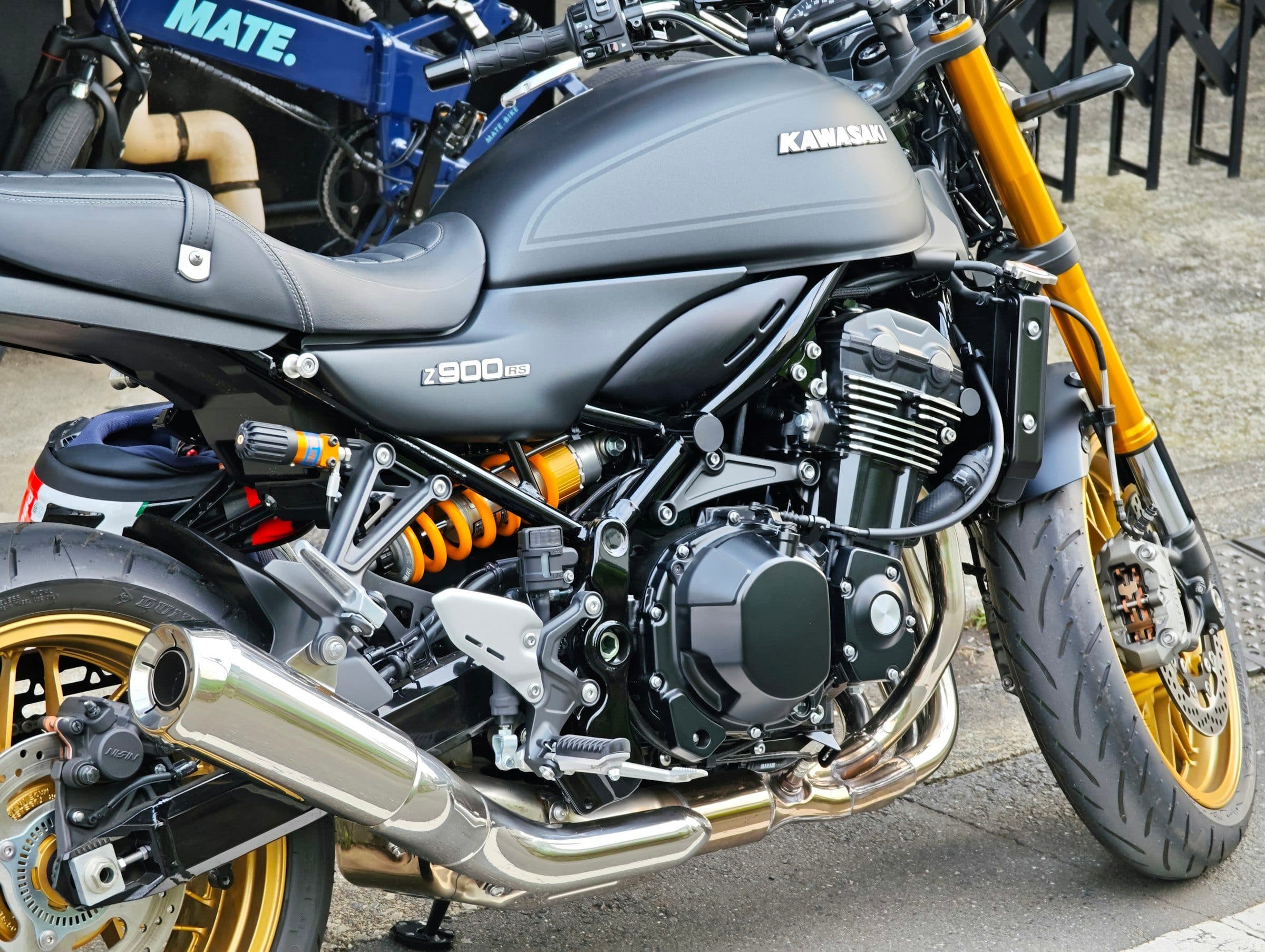
- The current best sellers are the Honda Rebel 250, Kawasaki Eliminator (400cc) and Kawasaki Z900RS, with retro styling everywhere.
- Rental fleets follow the same pattern, so a 250cc to 400cc bike is the easiest size to rent as a visitor.
How Japanese licences shape the market
In many countries one motorcycle licence covers everything, sometimes with an experience limit for new riders. Japan instead splits motorcycle licences by engine size, and each step means another course and test.
| Licence | Engine size | Minimum age |
|---|---|---|
| Gentsuki (moped) | Up to 50cc, or up to 125cc limited to 4 kW (since April 2025) | 16 |
| Kogata gentei futsū nirin (small) | Up to 125cc | 16 |
| Futsū nirin (ordinary) | Up to 400cc | 16 |
| Ōgata nirin (large) | No limit | 18 |
Every class except the moped licence also comes in an automatic-only version for scooters. The class that matters most is the middle one. The futsū nirin licence is what most Japanese riders hold, and it stops at 400cc. That single number explains a big part of the market.
Why 400cc bikes exist
On 1 October 1975, Japan changed its licence rules so that bikes over 400cc needed an unrestricted licence. Until the mid-1990s that licence couldn't be earned at a driving school: riders had to pass a practical test at a police test centre, which had a reputation for being very hard to pass. Most riders stayed on the mid-size licence, so the makers built bikes to fit it. Honda, for example, added a 398cc version of its CB400 Four in 1976.
The result was a whole class of bikes that barely exists outside Japan: 400cc four-cylinder sports bikes and naked bikes, built to feel like big bikes within the mid-size licence. They were at the heart of the 1980s motorcycle boom, and the class is still alive:
- Honda CB400 Super Four. For decades it was the bike Japanese driving schools trained on, and the default first “real” bike for many riders. Honda stopped making it in 2022, then brought it back with a newly designed 399cc four-cylinder and Honda's E-Clutch, which lets you ride without using the clutch lever. It went on sale on 21 August 2026 for ¥998,800.
- Kawasaki Ninja ZX-4R. A high-revving 399cc four-cylinder sports bike, launched in 2023 and now one of the best sellers in its class.
- Kawasaki Eliminator. A 398cc twin-cylinder cruiser with a low seat, and the best seller between 250cc and 400cc in the first half of 2023, 2024 and 2025.
- Honda GB350. Strictly a 348cc, this simple single-cylinder retro bike is one of the most popular bikes on the mid-size licence.
Since the mid-1990s, Japanese riders have been able to take the large motorcycle licence at a driving school, which made big bikes far easier to get. But the mid-size licence is still where most people start, and many never go further.
Why 250cc is the sweet spot
The most popular size of all is 250cc, and the reason is mostly paperwork and running costs. In Japanese law a motorcycle from 126cc to 250cc is a kei nirin (light motorcycle), and anything bigger is a kogata nirin (small motorcycle, despite the name). That line at 250cc changes a lot:
| 126cc to 250cc | Over 250cc | |
|---|---|---|
| Shaken (vehicle inspection) | Not required | After 3 years for a new bike, then every 2 years |
| Annual vehicle tax | ¥3,600 | ¥6,000 |
| Expressways | Allowed | Allowed |
| Licence needed (Japanese) | Futsū nirin | Futsū nirin up to 400cc, ōgata nirin above |
Shaken is Japan's compulsory roadworthiness inspection. It involves fees, compulsory insurance paid in advance and often a workshop visit, so skipping it saves owners money and hassle every two years. A 250cc bike also has enough power for expressways, which 125cc bikes can't use, and is light enough for narrow mountain roads and city parking. For many riders it is the best value in Japanese motorcycling.
That is why the 250cc class is crowded with well-built bikes: cruisers such as the Honda Rebel 250, retro bikes such as the Kawasaki W230 and Honda CL250, adventure bikes such as the Suzuki V-Strom 250SX, and sports bikes such as the Honda CBR250RR and Kawasaki Ninja 250.
125cc: the Super Cub and scooters
Below 250cc sits the 125cc class, Japan's everyday transport. These are the bikes delivering mail and newspapers, parked outside train stations and ridden by commuters in every city.
- Honda Super Cub. The best-selling motor vehicle in history, with more than 100 million built since 1958. In Japan it comes as the Super Cub 110, Super Cub C125, Cross Cub and the trail-style CT125 Hunter Cub, which is popular with touring riders.
- Honda PCX. A 125cc and 160cc scooter that is one of the best-selling bikes in Japan. The PCX160 is the second-best seller between 126cc and 250cc.
Bikes from 51cc to 125cc follow the normal speed limits but are not allowed on expressways, which limits them to local riding. Japanese owners also like their low running costs: a 125cc bike can use the motorcycle add-on of a family car insurance policy, which is cheap.
The smallest class is changing. Tighter emissions rules from November 2025 make it hard to keep building 50cc mopeds, so since April 2025 a moped licence also covers bikes up to 125cc whose power is limited to 4 kW (about 5.4 hp). These new-standard mopeds, such as the Honda Super Cub 110 Lite, follow the old moped rules: a 30 km/h speed limit and two-stage right turns at some junctions.
The best sellers right now
These are the best-selling new bikes in Japan in the first half of 2025, estimated by the motorcycle trade paper Nirin Shimbun. Japan's official statistics count bikes by size class, not by model, so these estimates are the standard source.
126cc to 250cc
| Model | Units (Jan to Jun 2025) | |
|---|---|---|
| 1 | Honda Rebel 250 | 4,266 |
| 2 | Honda PCX160 | 3,310 |
| 3 | Kawasaki W230 / Meguro S1 | 2,966 |
| 4 | Honda ADV160 | 2,406 |
| 5 | Kawasaki KLX230 series | 1,591 |
251cc to 400cc
| Model | Units (Jan to Jun 2025) | |
|---|---|---|
| 1 | Kawasaki Eliminator | 1,973 |
| 2 | Honda GB350 / GB350 S | 1,609 |
| 3 | Kawasaki Ninja ZX-4R / ZX-4RR | 1,359 |
| 4 | Honda GB350 C | 931 |
| 5 | Honda CBR400R / NX400 | 683 |
Over 400cc
| Model | Units (Jan to Jun 2025) | |
|---|---|---|
| 1 | Kawasaki Z900RS | 2,472 |
| 2 | Honda CB1300 Super Four / Super Bol d'Or | 1,260 |
| 3 | Harley-Davidson Low Rider S / ST | 1,219 |
| 4 | Honda CB650R / CBR650R | 1,137 |
| 5 | Honda X-ADV | 823 |
Over the whole of 2025, Japan's new motorcycle sales were 61,990 bikes from 126cc to 250cc, up 8%, and 84,259 bikes over 250cc, down 4%. Honda was the biggest maker in both classes, and Harley-Davidson was again the best-selling imported brand.
Big bikes: the Z900RS and friends
Japanese riders who take the large licence tend to buy big bikes with character rather than the fastest sports bike. The Kawasaki Z900RS, a modern 948cc bike styled after the 1970s Kawasaki Z1, was the best-selling bike over 400cc in Japan every year from 2018 to 2024, and again in the first half of 2025. The Honda CB1300 Super Four, a big, comfortable four-cylinder, has been a long-running favourite too.
Imports are a big part of this class. Harley-Davidson has been Japan's best-selling imported motorcycle brand every year since at least 2010, and BMW's GS adventure bikes and Triumph's Bonneville family appear regularly in the top-ten lists.
Why retro is everywhere
Look down the best-seller lists and a pattern stands out: the Z900RS, GB350, W230, Meguro S1, Eliminator and Rebel 250 are all retro or classic in style. A few reasons come together:
- Easy to ride. Retro bikes and cruisers usually have low seats, upright riding positions and gentle power, which suit new riders, riders coming back after years away, and Japan's narrow roads and low speed limits.
- Nostalgia. Many riders who grew up in the 1980s boom are back on bikes, and the makers revive names and designs from that era, such as Kawasaki's Meguro and W brands.
- New riders. A growing number of younger and female riders choose light, low bikes. The Rebel 250's 690 mm seat is a big part of its success.
- Clutch-free riding. Honda's E-Clutch, now on the Rebel 250 and the new CB400 Super Four, removes the trickiest part of learning to ride.
What this means if you visit
Japan's licence tiers apply to Japanese licences. As a visitor you ride on your home licence and a 1949 International Driving Permit showing the motorcycle category, and the rental shop checks that your home licence covers the size of bike you book.
Rental fleets mirror the market, so the easiest bikes to find are 250cc to 400cc: Rebel 250s, CB400s, GB350s, Ninja 400s and their rivals. They are also the right size for most visitors. Japanese mountain roads are narrow and twisty and speed limits are low, so a light mid-size bike is often more fun than a big tourer. Choose something over 125cc if your route uses expressways. Our guide to renting a motorcycle in Japan covers the documents, costs and insurance.
Ride Japan with us
Our guided motorcycle tours start near Kyoto and include the rental bike from our partner shop, with an English-speaking ride leader who knows the roads. You still need your own licence and International Driving Permit. Browse the motorcycle tours or ask us anything about riding in Japan.
Please note. We wrote this guide in October 2026. Sales figures by model are estimates from Nirin Shimbun, and taxes, fees and licence rules can change. This is general information, not legal advice.
Sources
- Honda: Motorcycle licence types (Japanese)
- Webike Plus: Best sellers up to 400cc, first half of 2025, Nirin Shimbun estimates (Japanese)
- Webike Plus: Best sellers over 400cc, first half of 2025, Nirin Shimbun estimates (Japanese)
- Response: 2025 new motorcycle sales by class (Japanese)
- Response: Honda CB400 Super Four E-Clutch launch (Japanese)
- Young Machine: The 1975 licence change and the 400cc class (Japanese)
- Norimono News: The new-standard moped rules from 2025 (Japanese)
- BikeBros: Motorcycle shaken (vehicle inspection) guide (Japanese)
Frequently asked questions
Why are 400cc motorcycles so popular in Japan?
Because of the licence system. The standard motorcycle licence, the futsū nirin (ordinary two-wheeler) licence, covers bikes up to 400cc and can be taken at a driving school from age 16. Anything bigger needs a separate large motorcycle licence. Since 1975, 400cc has been the most a rider can have without that extra step, so Japanese makers build bikes right up to the limit, often 398cc or 399cc.
Why do so many Japanese riders choose 250cc bikes?
Motorcycles of 250cc and under don't need shaken, Japan's compulsory vehicle inspection, which bikes over 250cc must pass three years after they are new and every two years after that. 250cc bikes also pay less annual tax, are light and cheap to run, and, unlike 125cc bikes, are allowed on expressways.
What is the best-selling motorcycle in Japan?
Among bikes over 125cc, the Honda Rebel 250 has been the best seller for several years. In the first half of 2025 it sold an estimated 4,266 units, according to the trade paper Nirin Shimbun. The Kawasaki Eliminator led the 250cc to 400cc class, and the Kawasaki Z900RS led the bikes over 400cc.
What licence do you need to ride a 400cc motorcycle in Japan?
A Japanese futsū nirin (ordinary two-wheeler) licence, available from age 16, covers up to 400cc. Over 400cc needs an ōgata nirin (large two-wheeler) licence, available from age 18. Visitors don't take these tests: they ride on their home licence with a 1949 International Driving Permit showing the motorcycle category, and the rental shop checks that their home licence covers the bike.
Can 125cc motorcycles use expressways in Japan?
No. Motorcycles of 125cc and under are not allowed on expressways or the Tokyo Shuto Expressway. You need a bike over 125cc for expressway riding.
Is the Honda CB400 Super Four still made?
Yes, again. Honda stopped making it in 2022, then brought back a new CB400 Super Four with a newly designed 399cc four-cylinder engine and Honda's E-Clutch. It went on sale in Japan on 21 August 2026 at ¥998,800 including tax.