
Blog · 1 November 2026 · 8 min read
Byodo-in is the temple on Japan's 10-yen coin. Its Phoenix Hall, finished in 1053 on an island in a pond, is one of the very few wooden buildings in Japan that survive from the Heian period, when Kyoto's aristocrats ran the country. It was built as a vision of paradise, and it still looks like one. This guide explains what you're looking at, how to see inside the hall, what's in the museum, and how to plan your visit.
The short version
- The Phoenix Hall (1053) is on the 10-yen coin, and a phoenix from its roof was on the 10,000-yen note from 2004.
- Admission is 700 yen for the garden and the Hoshokan museum. Going inside the hall is 300 yen more, cash only, at set times for up to 35 people.
- Buy your Phoenix Hall ticket first, as soon as you arrive, because busy days sell out.
- Don't skip the Hoshokan museum: the original phoenixes, the bell and 26 of the carved bodhisattvas are there.
- Byodo-in is open every day, a 10-minute walk from Uji Station, which is 17 minutes from Kyoto Station.
Why Byodo-in was built
In the 11th century the Fujiwara family ruled Japan in all but name, marrying their daughters to emperors and governing as regents. Uji, on the river between Kyoto and Nara, was where they built their country villas. Fujiwara no Michinaga, the most powerful of them, owned a villa here. (Murasaki Shikibu, who wrote The Tale of Genji, served at court under his daughter, and the last chapters of her story are set in Uji.)
In 1052 Michinaga's son Yorimichi turned the villa into a temple. The year mattered. Many people at the time believed 1052 was the first year of mappo, the age of decline when Buddhist teaching would lose its power and people could no longer reach enlightenment by their own efforts. The hope that remained was Amida Buddha, who had vowed to bring anyone who called on him to his Pure Land, a paradise in the west. Yorimichi built the Phoenix Hall the following year as an image of that paradise on earth.
Most of the temple burned in fighting in 1336, but the Phoenix Hall survived. Today Byodo-in doesn't belong to a single Buddhist school: two sub-temples, one of the Jodo school and one connected with Tendai, look after it together. Since 1994 it has been part of the UNESCO World Heritage Site “Historic Monuments of Ancient Kyoto”.
The Phoenix Hall
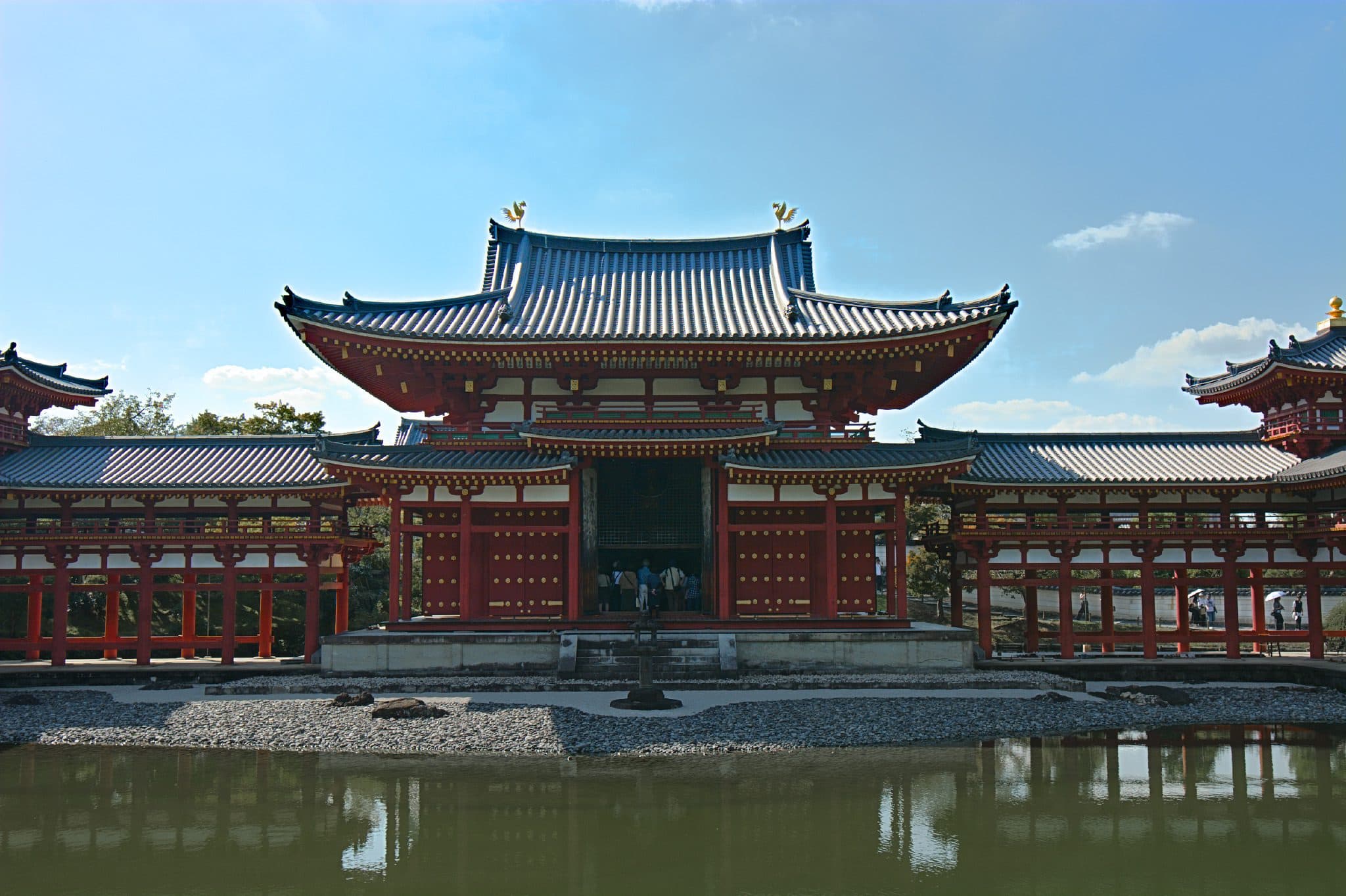
The hall's real name is Amida-do, the Amida Hall. People started calling it the Phoenix Hall (鳳凰堂, Hoodo) in the Edo period, centuries later, because of its shape and its roof:
- A bird with spread wings. A central hall is flanked by two wing corridors, with a third corridor running out behind like a tail. Seen from across the pond, the whole building looks like a bird about to take off.
- Two bronze phoenixes stand at each end of the main roof. The ones you see today are replicas put up in the late 1960s. The 11th-century originals, both National Treasures, are in the museum.
- The pond. The hall sits on an island and faces east across the water, so you look at it the way you would look toward Amida's paradise in the west. Through the round opening in the lattice above the doors, you can see the face of the Amida Buddha inside.
Between 2012 and 2014 the hall was re-roofed and its pillars and woodwork repainted, which is why the red looks so fresh in photos.
The 10-yen coin and the 10,000-yen note
You probably have Byodo-in in your wallet already. The Phoenix Hall has been on the 10-yen coin since 1951: turn one over and you'll see the hall with its wings and the pond in front. Holding one up against the real thing is a favourite photo.
The south phoenix from the roof appears on the back of the 10,000-yen note issued from 2004, the one with Fukuzawa Yukichi on the front. That note is still legal tender and still common. The new 10,000-yen note issued in 2024 shows Tokyo Station on the back instead, so check which one you have.
Going inside the Phoenix Hall
Your admission ticket covers the garden and the museum. Going inside the hall is a separate, short visit:
| Details | |
|---|---|
| Price | 300 yen, cash only |
| Times | Every 20 minutes, from 9:30 to 16:10 |
| Group size | Up to 35 people per visit |
| Length | About 15 minutes |
| Tickets | At the reception in the garden, from 9:10, for a set time. Arrive 5 minutes early. |
| Language | Spoken explanation in Japanese only; English leaflet available |
| Photos | Not allowed inside |
Inside, you see what the building was made for:
- The Amida Buddha, seated, 277 cm tall and covered in gold leaf, completed in 1053 by the sculptor Jocho. It's a National Treasure and the only statue known to survive that can be firmly credited to Jocho, whose style shaped Japanese Buddhist sculpture for centuries.
- Bodhisattvas on clouds. Fifty-two small wooden figures ride clouds around the upper walls, playing instruments, dancing and praying: Amida's attendants coming to welcome the dying to paradise. Some on the walls today are replicas, and 26 originals are displayed in the museum.
- Painted doors and walls showing Amida descending to meet the faithful, an early example of the Japanese yamato-e style of painting. They've faded, but you can still make out figures and landscapes.
On busy days, the visits for the rest of the day can sell out and the reception may close early. Ceremonies and stormy weather can also cancel visits without notice.
The Hoshokan museum
Many visitors skip Byodo-in's museum, which is a mistake: it holds the temple's originals, and it's included in your ticket. The Hoshokan opened in 2001. Highlights:
- The original pair of phoenixes from the roof, close enough to see the detail you can't make out from the garden.
- The temple bell, a National Treasure. An old saying ranks three bells as the finest in Japan, and Byodo-in's is the one praised for its shape. The bell hanging in the garden is a replica.
- 26 of the bodhisattvas on clouds, at eye level, so you can see their instruments and faces.
Photos aren't allowed inside the museum.
Tickets and opening hours
| Details | |
|---|---|
| Admission (garden and museum) | 700 yen adults, 400 yen junior high and high school, 300 yen elementary school |
| Phoenix Hall interior | 300 yen extra, cash only |
| Garden | 8:45 to 17:30, last entry 17:15 |
| Hoshokan museum | 9:00 to 17:00, last entry 16:45 |
| Phoenix Hall interior visits | 9:30 to 16:10, every 20 minutes |
| Closed | Open every day of the year |
| Payment | Cards, QR payments and e-money for admission; cash only for the Phoenix Hall and temple stamps |
A ticket lets you in once. If you have a Phoenix Hall ticket for later, you can leave and come back in for it by showing it at the main gate.
If you're visiting in November 2026. The museum's room of painted doors is closed on weekdays from 2 to 27 November for a survey of the paintings (open at weekends and on 23 November). On 10 and 11 November there's maintenance work on the Phoenix Hall, so expect workers and ladders around the building and on its roof.
Tips for your visit
- Go early. The garden opens at 8:45, before the tour groups. Head straight for the Phoenix Hall reception and book a visit, then walk the pond and see the museum while you wait.
- Bring coins. The Phoenix Hall visit is cash only, and you'll want a 10-yen coin for the photo.
- Walk all the way around the pond. The classic view is from the east bank, straight across the water, but the side views show the wings and the tail corridor.
- Pets are allowed in the garden on a lead or in a carrier, but not inside the Phoenix Hall or the museum. The inside of the hall isn't wheelchair accessible; the garden is, and wheelchairs can be borrowed.
- No parking. Byodo-in has no car park of its own, though there are paid car parks nearby. The train is easier.
- Make a half day of it. Across the river are Uji Shrine and Ujigami Shrine, the oldest surviving shrine building in Japan, and the street leading to Byodo-in is lined with tea shops. Our Uji matcha guide covers where to drink and buy tea.
Getting there
Byodo-in is at 116 Uji Renge in Uji, south of Kyoto. Both Uji stations are about a 10-minute walk away.
| From | How | Time |
|---|---|---|
| Kyoto Station | JR Nara Line (Miyakoji Rapid) to Uji | 17 minutes, then 10 minutes on foot |
| Gion-Shijo or Sanjo | Keihan Main Line to Chushojima, then Keihan Uji Line to Uji | About 30 minutes, then 10 minutes on foot |
| Nara | JR Nara Line (Miyakoji Rapid) to Uji | 31 minutes, then 10 minutes on foot |
| Osaka | JR to Kyoto, then the JR Nara Line to Uji | About 50 minutes, then 10 minutes on foot |
Uji is on the same JR line as Fushimi Inari, so you can easily see both in one day.
See Byodo-in with a guide
Byodo-in is beautiful on its own, but the story behind it is easy to miss. On our two-hour Uji walking tour, your guide explains how the Fujiwara built a paradise here, what the Phoenix Hall was meant to show and how it ended up on the 10-yen coin. Then you cross the river to Uji Shrine, Ujigami Shrine and Uji Bridge, the setting of the last chapters of The Tale of Genji. The tour ends near the tea shops, so you can stay on for matcha or go back to Byodo-in for a Phoenix Hall visit. See tour dates and prices.
Please note. We wrote this guide in November 2026 from Byodo-in's official website. Prices, opening hours and Phoenix Hall visits can change, so check the temple's website before you go.
Sources
- Byodo-in: Visitor guide (hours and fees)
- Byodo-in: Visiting the interior of the Phoenix Hall
- Byodo-in: History
- Byodo-in: Sculpture
- Byodo-in: Hoshokan Museum
- Byodo-in: FAQ
- Byodo-in: Access
- Bank of Japan: Banknotes and coins in circulation (Japanese)
- Wikipedia: Byōdō-in
Frequently asked questions
Is Byodo-in the temple on the 10-yen coin?
Yes. The Phoenix Hall of Byodo-in has been on Japan's 10-yen coin since 1951. One of the bronze phoenixes from its roof is also on the back of the 10,000-yen note issued from 2004, which is still in use. The new 10,000-yen note issued in 2024 shows Tokyo Station instead.
How much does it cost to visit Byodo-in?
Admission is 700 yen for adults, 400 yen for junior high and high school students and 300 yen for elementary school students. It covers the garden and the Hoshokan museum. Going inside the Phoenix Hall costs another 300 yen, paid in cash at a reception desk in the garden.
Can you go inside the Phoenix Hall?
Yes, in small groups at set times. Visits run every 20 minutes from 9:30 to 16:10, with up to 35 people each, and last about 15 minutes. Tickets for a set time are sold at the reception in the garden from 9:10, cash only. On busy days the day's visits can sell out, so buy your ticket as soon as you arrive. The explanation inside is in Japanese only, but there's an English leaflet.
Is it worth going inside the Phoenix Hall?
If you can get a ticket, yes. Inside you stand in front of the gilded Amida Buddha by the sculptor Jocho, completed in 1053 and a National Treasure, with carved bodhisattvas on clouds playing music around the walls above. From the garden you only see the statue's face through a window in the front of the hall.
How long do you need at Byodo-in?
Allow about an hour and a half: half an hour to walk around the pond, 15 minutes inside the Phoenix Hall and 30 to 45 minutes in the Hoshokan museum. Add waiting time if your Phoenix Hall visit is later in the day.
Can you take photos at Byodo-in?
You can take photos in the garden for personal use. Photos aren't allowed inside the Phoenix Hall or the Hoshokan museum, and drones are banned in and around the temple.
How do you get to Byodo-in from Kyoto?
Take the JR Nara Line from Kyoto Station to Uji Station, 17 minutes on a Miyakoji Rapid, then walk about 10 minutes. From Gion-Shijo or Sanjo, take the Keihan Main Line to Chushojima and change to the Keihan Uji Line for Uji Station, about 30 minutes in all, then walk about 10 minutes.