
Blog · 27 October 2026 · 9 min read
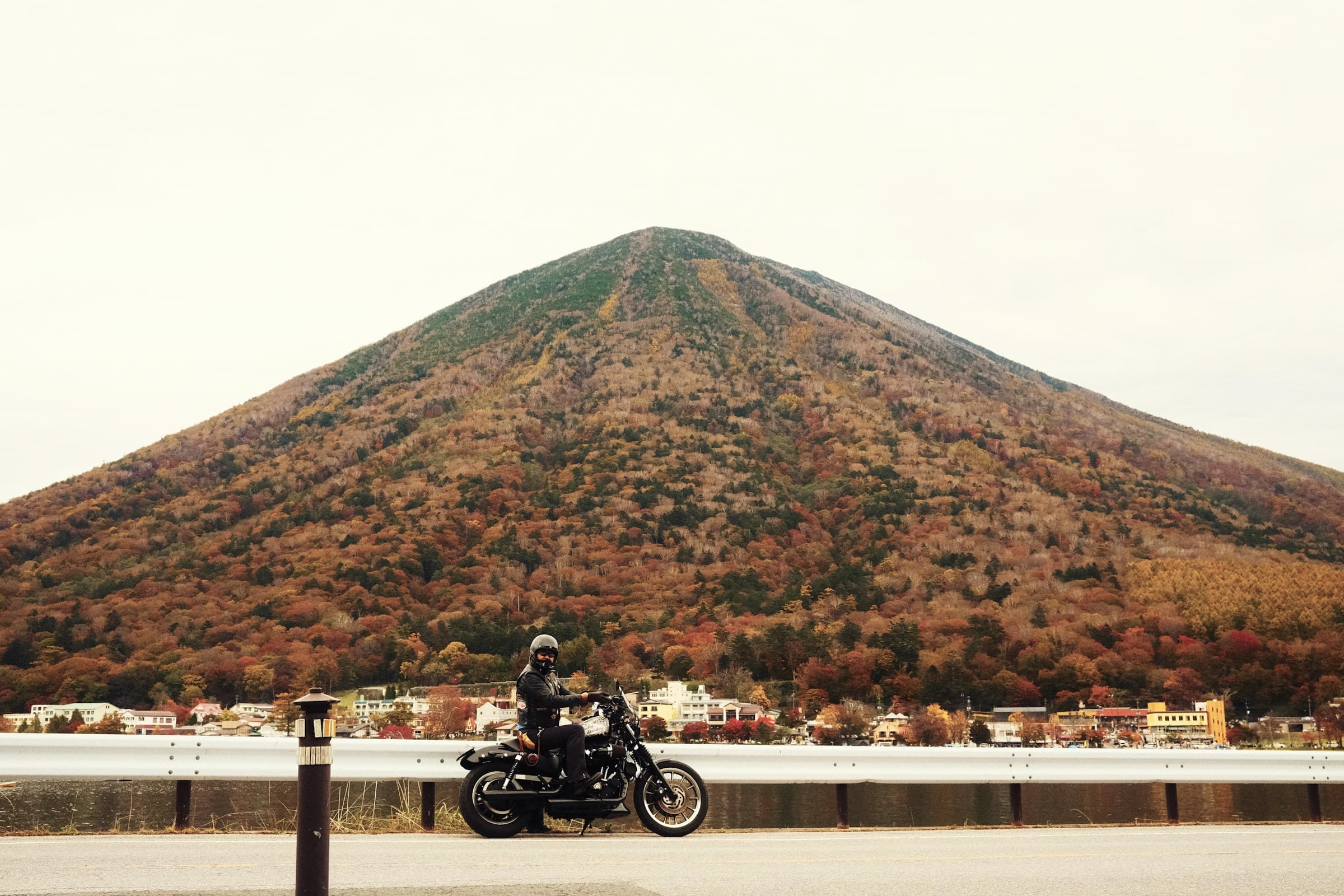
Photo: ZENG YILI on Unsplash
Japan is a wonderful country to ride, but the seasons make a bigger difference here than in most places. The same mountain road can be perfect in October, a sauna in August and closed by snow in January. Two of the worst stretches, the rainy season and the typhoon peak, fall exactly when many visitors plan their trips. Here is what each season is like on a motorcycle, the best and worst times to ride, and the reasons behind them.
The short version
- Best: October to mid-November, and mid-April to May (but not Golden Week).
- Good with care: late March to early April, early June, late November.
- Worst: the rainy season (about 6 June to 19 July around Kyoto), August (heat, typhoons and holiday traffic) and December to February (ice, snow and closed mountain roads).
- Exceptions: Hokkaido is at its best in July and August, and Okinawa's rainy season comes a month earlier.
Month by month
The temperatures and rainfall below are the Japan Meteorological Agency's 1991–2020 averages for Kyoto, a good guide to central Honshu. Mountains are colder and the Sea of Japan coast is snowier in winter.
| Month | Average high | Rain | For riding |
|---|---|---|---|
| January | 9.1°C | 53 mm | Poor: cold, icy mountain roads |
| February | 10.0°C | 65 mm | Poor: the coldest stretch of the year |
| March | 14.1°C | 106 mm | Fair: warming up, cold mornings |
| April | 20.1°C | 117 mm | Good: cherry blossoms early, very good later |
| May | 25.1°C | 151 mm | Very good, apart from Golden Week |
| June | 28.1°C | 200 mm | Poor: the rainy season starts |
| July | 32.0°C | 224 mm | Poor: rain, then heat |
| August | 33.7°C | 154 mm | Worst: heat, typhoons, Obon traffic |
| September | 29.2°C | 179 mm | Fair: still hot, typhoon peak |
| October | 23.4°C | 143 mm | Best |
| November | 17.3°C | 74 mm | Very good: dry, autumn leaves |
| December | 11.6°C | 57 mm | Poor: cold, short days |
Best: autumn (October to mid-November)
Autumn is the best time to ride in Japan, for several reasons that all land at once:
- The heat has gone. Kyoto's average high falls from 33.7°C in August to 23.4°C in October and 17.3°C in November, which is ideal in full riding gear.
- It is dry. November is one of the driest months of the year, with about a third of July's rainfall.
- Typhoons fade out. October still sees some typhoons (on average 1.7 come close to Japan), but far fewer than August and September, and by November they are rare.
- The leaves turn. The autumn colours start in the mountains in October and reach Kyoto from mid-November to early December. Riding a mountain pass through red and gold maples is the classic Japanese motorcycle trip.
What to watch for. Mornings in the mountains can be close to freezing by November, so bring layers and winter gloves. Fallen wet leaves are slippery on shaded corners. The days get short: by late November the sun sets before 5 pm, so plan to be off the mountain roads before dark. And the most famous autumn-leaf spots get very busy at weekends in mid to late November.
Best: spring (mid-April to May)
Spring is the other great season. Kyoto's average high is about 20°C in April and 25°C in May: warm enough for comfortable riding, cool enough that you don't overheat at traffic lights. The countryside is a fresh, bright green, and the rice paddies are flooded for planting in May, which turns rural valleys into mirrors.
Cherry blossom season, from late March to early April around Kyoto, is beautiful but mixed for riding. Mornings are still cold, especially in the mountains, and the famous blossom spots are packed. The weeks just after the blossoms fall are often better.
What to watch for. Golden Week, from 29 April to 5 May, is Japan's busiest holiday period: expressways jam, rest stops fill up and hotels in popular areas sell out and raise their prices. Some high mountain roads are still closed by snow in April and May (see regions).
Worst: the rainy season (June to mid-July)
Japan's rainy season, tsuyu, is a stretch of grey, wet weeks caused by a weather front that stalls over the country. In the Kyoto and Osaka region it starts around 6 June and ends around 19 July on average, and June and July bring Kyoto's highest rainfall of the year.
Why it is bad for riding:
- It isn't just showers. Some days are only drizzly, but the season also brings heavy, long-lasting downpours that can cause landslides and close mountain roads.
- Wet roads are slippery. Painted lines, manhole covers, metal grates and the steel plates at road works are especially slippery when wet, and many Japanese mountain roads are narrow and shaded, so they stay damp and mossy.
- You lose the views. Low cloud hides the mountains and coast that you came to see.
The dates move every year and from region to region (see regions). If you can only travel in June, the first week is often still fine, and good waterproofs make a big difference.
Worst: high summer and typhoons (late July to September)
Once the rainy season ends, Japan heats up fast. Kyoto's average high in August is 33.7°C, many days go over 35°C, and the humidity is high. In a jacket, gloves and a full-face helmet, sitting in traffic in that heat is miserable and can be dangerous: heatstroke is a real risk. Afternoon thunderstorms are also common.
Summer is also typhoon season. Typhoons can reach Japan from May to November, but August and September are the peak: on the 1991–2020 averages, about 3.3 typhoons come close to Japan in each of those months, and of the roughly 3 that make landfall each year, about two land in August or September. A typhoon brings strong winds and very heavy rain, ferries and roads close, and you may have to sit out a day or two.
If you ride in summer. Start at dawn and stop in the early afternoon, drink at every stop, use a mesh jacket, and head north or up into the mountains, where it is several degrees cooler. Follow the typhoon forecasts and keep a spare day in your plans.
Worst: winter (December to February)
On a dry winter day, riding around Kyoto or Osaka is cold but possible: Kyoto's average January high is 9.1°C. For touring, though, winter is the worst season:
- Ice. Kyoto's average January low is 1.5°C, and higher up it is well below freezing. Shaded corners, bridges and mountain passes ice over, often where you can't see it.
- Snow. The Sea of Japan side of the country and the Japanese Alps get some of the heaviest snow in Japan. Northern Kyoto Prefecture, Hokuriku, Hida and Takayama get regular snow.
- Closed roads. Many of the best scenic mountain roads close for the winter. The Hakusan Shirakawa-go White Road, for example, closes from November to the following June.
- No winter tyres. When it snows, expressways and many main roads bring in winter-tyre restrictions, which only let through vehicles with winter tyres or chains. Rental motorcycles run on normal tyres.
- Short days. In December the sun sets well before 5 pm.
Holidays to avoid
Japanese holidays matter almost as much as the weather. Three periods are best avoided for touring:
| Holiday | Dates | What happens |
|---|---|---|
| Golden Week | 29 April to 5 May | Expressway jams, full and expensive hotels |
| Obon | About 13 to 16 August | Mass travel to home towns on top of the summer heat |
| New Year | About 29 December to 3 January | Heavy traffic; many restaurants and shops close |
Weekends during the autumn leaves and cherry blossoms are busy too, especially near Kyoto. Riding on weekdays makes a big difference.
How it changes by region
Japan is long, so the seasons don't arrive everywhere at once. These are the Japan Meteorological Agency's average rainy season dates:
| Region | Rainy season starts | Rainy season ends |
|---|---|---|
| Okinawa | About 10 May | About 21 June |
| Shikoku | About 5 June | About 17 July |
| Kinki (Kyoto, Osaka) | About 6 June | About 19 July |
| Kanto (Tokyo) | About 7 June | About 19 July |
| Hokuriku (Kanazawa) | About 11 June | About 23 July |
| Northern Tohoku | About 15 June | About 28 July |
| Hokkaido | No official rainy season | — |
- Hokkaido is the big exception. It has no official rainy season and stays cool in summer, so July and August, the worst months on Honshu, are its best riding season. It is far too snowy to ride in winter.
- High mountain roads in the Alps and Hokuriku often open only in late spring or early summer and close again in November. Check the opening dates before you plan a route over a famous pass.
- The Sea of Japan coast is lovely from spring to autumn but gets heavy snow in winter, while the Pacific side stays drier and sunnier.
- Okinawa is warm all year, but its rainy season comes about a month earlier, and it is right in the path of summer typhoons.
Planning your trip
If you can choose your dates, aim for October or the first half of November, or for mid-April to May outside Golden Week. Whatever the season, bring proper waterproofs, check the weather each morning and keep a spare day for bad weather. You will also need your home licence and an International Driving Permit, and our guide to renting a motorcycle in Japan covers the rest.
Ride Japan with us
Our guided motorcycle tours start near Kyoto, with an English-speaking ride leader who knows the roads and plans around the weather. Browse the motorcycle tours or ask us anything about riding in Japan.
Please note. We wrote this guide in October 2026. Temperatures, rainfall and rainy season dates are long-term averages, and every year is different. Check the forecast and road conditions before you ride.
Sources
- Japan Meteorological Agency: Kyoto climate normals, 1991–2020 (Japanese)
- Japan Meteorological Agency: Rainy season start and end dates (Japanese)
- Japan Meteorological Agency: Typhoon normals by month (Japanese)
- Weathernews: Why Hokkaido has no rainy season (Japanese)
- Kumamoto Nichinichi Shimbun: Hakusan Shirakawa-go White Road opens for 2026 (Japanese)
- ATIS: Winter tyre and chain restrictions (Japanese)
- Walkerplus: When the autumn leaves peak in Kyoto (Japanese)
Frequently asked questions
What is the best month to ride a motorcycle in Japan?
October is the safest bet for most of Honshu. The summer heat has gone, the rainy season is long over, typhoons are becoming less frequent, and in Kyoto the average high is about 23°C. May is a close second, as long as you avoid the Golden Week holidays at the start of the month.
When is the rainy season in Japan?
On average the rainy season (tsuyu) in the Kyoto and Osaka region runs from about 6 June to about 19 July, according to the Japan Meteorological Agency's 1991–2020 normals. Most of Honshu is similar, Okinawa starts and ends about a month earlier, and the agency doesn't declare a rainy season for Hokkaido.
Is it too hot to ride a motorcycle in Japan in summer?
July and August are hard work. Kyoto's average daily high in August is 33.7°C, and humidity is high, so in full riding gear it is easy to overheat. If you ride in summer, start at dawn, stop often to drink, and head north or into the mountains, where it is cooler.
When is typhoon season in Japan?
Typhoons can come from May to November, but August and September are the peak. On the 1991–2020 averages, about 3.3 typhoons come close to Japan in each of those months, and of the roughly 3 that make landfall each year, most do so in August and September.
Can you ride a motorcycle in Japan in winter?
In the cities on the Pacific side, yes, on dry days: Kyoto's average January high is about 9°C. But mountain roads ice over, the Sea of Japan side and the Alps get heavy snow, many scenic mountain roads close until spring, and rental bikes don't have winter tyres. For touring, winter is the worst season.
When is the best time to ride in Hokkaido?
July and August. Hokkaido has no official rainy season and stays much cooler than the rest of Japan in summer, which is exactly when Honshu is at its hottest.