
Blog · 27 October 2026 · 8 min read
For more than five hundred years, Japan's emperors lived in this walled palace in the middle of Kyoto. Today it is one of the city's best-value sights: entry is free, you don't need to book, and it is far quieter than Kyoto's famous temples. This guide covers what the Kyoto Imperial Palace is, what you see on a visit, the opening hours and rules, how to get there, and how to fit it into a day.
The short version
- Free entry, no booking. Walk in through the Seishomon Gate, with a bag check at the entrance.
- Closed Mondays (Tuesday if Monday is a holiday) and from 28 December to 4 January.
- Open from 9:00. The last entry is between 15:20 and 16:20 depending on the season.
- Free English tours at 10:00 and 14:00, about 50 minutes. No booking needed.
- You see the halls from outside; you can't go inside the buildings. Allow about an hour.
- Nearest station: Imadegawa on the Karasuma subway line, about 5 minutes' walk.
A short history
When Kyoto became Japan's capital in 794, the imperial palace stood about 2 km west of today's site. That first palace was abandoned in the late 12th century, and emperors moved between temporary residences. One of them, the Tsuchimikado mansion, became the permanent palace in the 14th century. It stayed the emperor's home until Emperor Meiji moved to Tokyo in 1869.
The palace burned down many times. The buildings you see today were rebuilt after a fire in 1854, and the main halls were designed in the style of the original Heian-period palace. Even after the move to Tokyo, the enthronement ceremonies of Emperors Taishō (1915) and Shōwa (1928) were held here in the Shishinden.
What you see on a visit
The visit is a one-way walk around the palace on wide gravel paths. Highlights along the route include:
- Okurumayose and Shodaibu-no-ma. The carriage porch where nobles arrived and the waiting rooms where officials sat by rank. The sliding doors are painted with tigers, cranes and cherry trees, and the room you waited in depended on your status.
- Kenreimon and Jomeimon gates. Kenreimon is the grand southern gate used by the emperor and for state ceremonies. Jomeimon, with its bright vermilion pillars, opens onto the main courtyard.
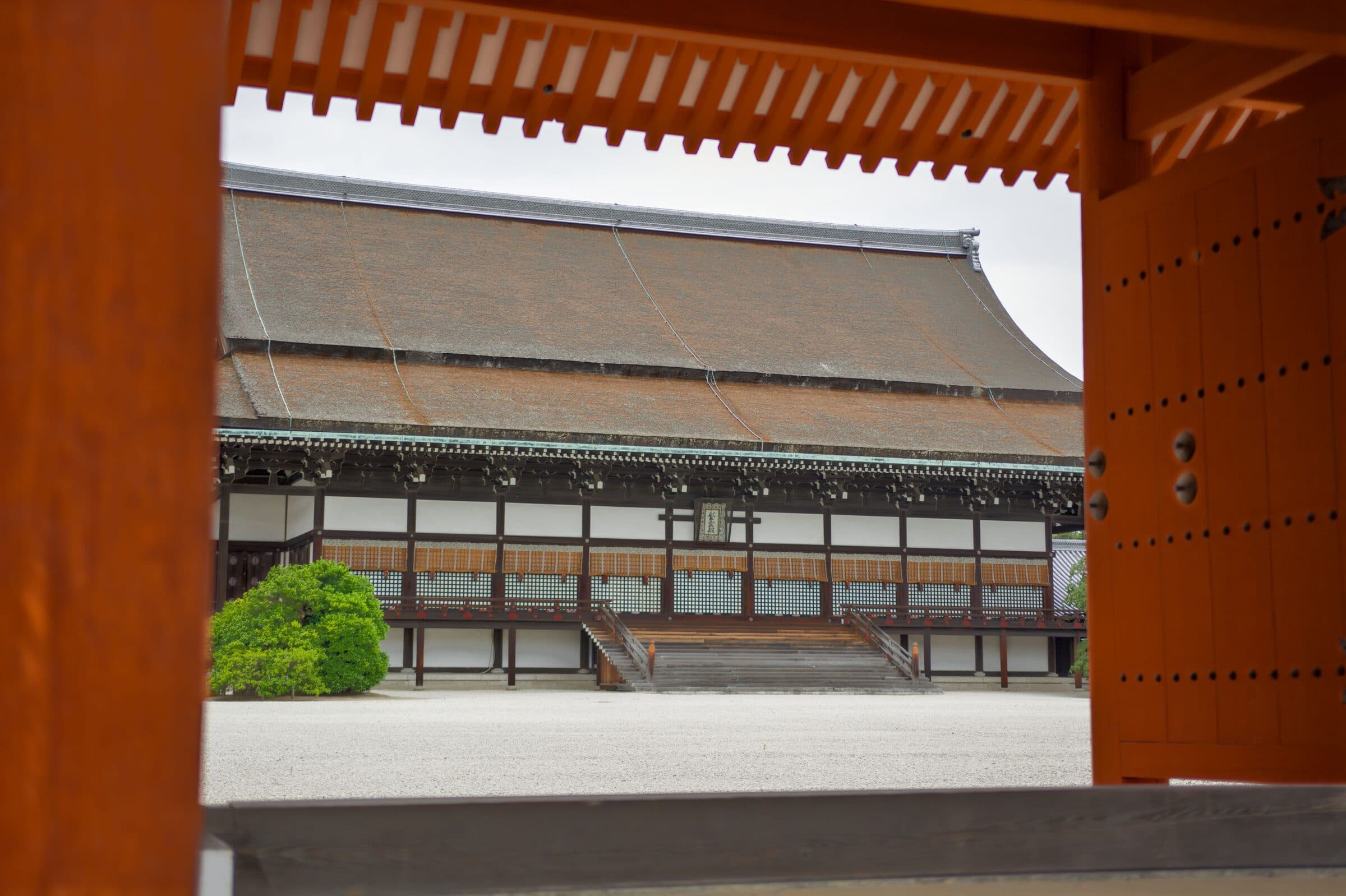
- Shishinden. The Hall for State Ceremonies and the heart of the palace: a huge hall with a sweeping cypress-bark roof, facing a courtyard of raked white gravel. A cherry tree and a tachibana orange tree stand on either side of its front steps.
- Seiryoden. Originally the emperor's living quarters, later used mainly for ceremonies.
- Kogosho. The hall where, on the night of 3 January 1868 (9 December 1867 in the old Japanese calendar), the meeting was held that decided the end of the Tokugawa shogunate's rule. The building was rebuilt after a fire in 1954.
- Oikeniwa. A pond garden with a pebble shore, stone bridges and pines, and one of the most photogenic spots on the route.
- Ogakumonjo and Otsunegoten. The emperor's study, used for lectures and poetry gatherings, and the residence where emperors lived day to day from the late 16th century.
You can't go inside any of the buildings, but many doors and screens are open so you can see the painted interiors from the walkways. Parts of the route can be under restoration, so some views may be screened off.
Opening hours and closed days
| Months | Opens | Last entry | Closes |
|---|---|---|---|
| April to August | 9:00 | 16:20 | 17:00 |
| March and September | 9:00 | 15:50 | 16:30 |
| October to February | 9:00 | 15:20 | 16:00 |
- Closed on Mondays (on Tuesday instead when Monday is a national holiday) and from 28 December to 4 January.
- Unplanned closures happen for court events, visits by dignitaries and bad weather. Check the Imperial Household Agency's calendar before you go.
- Special exhibitions are held a few times a year, usually in spring and autumn and around New Year, when extra rooms, screens or costumes are on display.
Guided tours and the audio guide
The Imperial Household Agency runs free guided tours of about 50 minutes. You don't need to book, although that may change if the tours get crowded, and groups should contact the palace in advance. Meet at the visitors' room before the start time.
| Language | Tour times |
|---|---|
| English | 10:00 and 14:00 |
| Chinese | 10:00 and 14:00 |
| Japanese | 9:30, 10:30, 13:30 and 14:30 |
There is also a free audio guide app in English, Japanese, Chinese, Korean, French and Spanish. Download it before you arrive so you don't rely on mobile data at the palace.
The free tours move at a steady pace and cover the main halls. If you want more time, more stories and the chance to ask questions, a private guided tour lets you go at your own speed.
Rules and tips
- Bag check. You and your bags are checked at the gate. Suitcases and other large luggage aren't allowed, so leave them at your hotel or a station locker.
- Not allowed: pets, eating, alcohol, smoking, drones, and camera stands for commercial filming.
- Photos for personal use are fine.
- Wear comfortable shoes. The whole route is on gravel, which is tiring in sandals and heels.
- Wheelchairs are available to borrow; ask the staff at the entrance.
- Shade is limited. The courtyards are wide open, so bring water and a hat in summer.
Getting there
The palace sits inside Kyoto Gyoen National Garden, in the centre of the city. The entrance is the Seishomon Gate on the palace's west side.
- Subway: Imadegawa Station on the Karasuma Line, about 5 minutes' walk.
- Bus: Karasuma Imadegawa bus stop, about 7 minutes' walk.
- Car and bicycle: the palace has no parking for cars or bicycles, so take public transport.
Kyoto Gyoen and the Sento Palace
The palace stands inside Kyoto Gyoen, a national garden about 700 m wide and 1.3 km long that used to be filled with the mansions of court nobles. Today it is a huge, free park open at all hours, with wide gravel avenues, the remains of noble estates and some of the city's best early cherry blossoms, such as the weeping cherry at the old Konoe mansion. It is a lovely place to walk before or after your visit.
In the southeast of the park is the Sento Imperial Palace, built for retired emperors and famous for its gardens. It is also free, but different from the Imperial Palace: you can only visit on a guided tour in Japanese, visitors must be 18 or older, and you register online in advance or on the day at the gate, from 8:40, while places last.
Combining it with Nijo Castle
The Imperial Palace pairs perfectly with Nijo Castle, about 2 km to the southwest. Together they tell both sides of Japanese history: the shogun's castle, built to show the Tokugawa family's power, and the emperor's palace, where that power was handed back in 1867 and 1868. You can walk between them in about 30 minutes, or take the subway.
On our private Nijo Castle and Imperial Palace tour, a Kyoto local guides you through both in about two and a half hours and fills in the story that connects them.
Please note. We wrote this guide in October 2026. Opening hours, tour times and rules can change, and the palace can close at short notice. Check the Imperial Household Agency's website before you go.
Sources
- Imperial Household Agency: Kyoto Imperial Palace visit guidelines
- Imperial Household Agency: Kyoto Imperial Palace access
- Imperial Household Agency: Opening hours for the Kyoto palaces
- Imperial Household Agency: Kyoto Imperial Palace visitor route map (PDF)
- Wikipedia: Kyoto Imperial Palace
- Ministry of the Environment: Kyoto Gyoen National Garden (Japanese)
Frequently asked questions
Is the Kyoto Imperial Palace free to visit?
Yes. Entry to the Kyoto Imperial Palace is free, and you don't need to book. Walk in through the Seishomon Gate during opening hours and go through a bag check.
What days is the Kyoto Imperial Palace closed?
It is closed on Mondays (or on Tuesday when Monday is a national holiday) and from 28 December to 4 January. It can also close at short notice for court events, visits by dignitaries or bad weather.
What are the Kyoto Imperial Palace opening hours?
It opens at 9:00 every day it is open. From April to August the last entry is 16:20 and it closes at 17:00; in March and September the last entry is 15:50 and it closes at 16:30; from October to February the last entry is 15:20 and it closes at 16:00.
Can you go inside the buildings at the Kyoto Imperial Palace?
No. Visitors can't enter any of the palace buildings. You see the halls from the courtyards and walkways, and many of the doors and sliding screens are open so you can look inside.
Is there an English tour of the Kyoto Imperial Palace?
Yes. The Imperial Household Agency runs free guided tours of about 50 minutes in English at 10:00 and 14:00, with no booking needed. Meet at the visitors' room before the start time. There is also a free audio guide app in English and five other languages.
How long do you need at the Kyoto Imperial Palace?
About an hour for the palace itself. The guided tour takes about 50 minutes. Add time to walk through the surrounding Kyoto Gyoen National Garden, which is free and open at all hours.
What is the difference between the Kyoto Imperial Palace and the Sento Imperial Palace?
The Kyoto Imperial Palace was the emperor's residence and is open for free walk-in visits. The Sento Imperial Palace, in the same park, was built for retired emperors and is known for its gardens. It is also free, but only by guided tour in Japanese, for visitors aged 18 and over, booked online or on the day.